
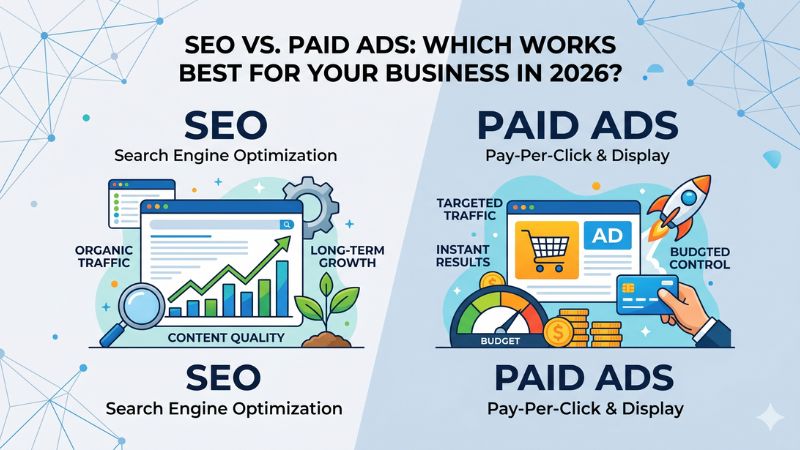
Every business owner investing in digital marketing eventually faces the same question: should I be spending my budget on SEO, on paid advertising, or on both? The answer has significant consequences — for how quickly you see results, how much you spend per lead, and how durable your online presence is over the next two to three years.
The frustrating reality is that most articles on this topic give you the same non-answer: "it depends." That is technically true but completely unhelpful. So this guide does something different. It gives you a clear, honest breakdown of what SEO and paid ads each actually deliver — with specific timelines, realistic cost expectations for the Indian market, and a concrete framework for deciding which channel deserves your budget at each stage of your business growth.
What this guide covers:
Search Engine Optimisation (SEO) is the practice of improving your website's visibility in organic (unpaid) search results on Google and other search engines. When someone in Delhi searches "best physiotherapy clinic near me" or "IT staff augmentation services Noida" and your business appears on the first page without you paying for that placement, that is SEO working.
SEO works through three interconnected elements. Technical SEO ensures your website is structured in a way that search engines can crawl, index, and understand — fast loading times, mobile responsiveness, clean URL structure, proper use of schema markup, and no broken links or duplicate content that confuses Google's crawlers. On-page SEO means your content is optimised around the specific keywords your customers use, with clear heading structures, well-written meta titles and descriptions, and internal linking that helps Google understand the relationship between your pages. Off-page SEO — primarily link building and brand authority signals — tells Google that other reputable websites consider your content worth referencing, which increases your domain authority and pushes your pages higher in results.
The economics of SEO are distinctive: the cost of ranking is front-loaded (agency fees, content creation, technical work) but the ongoing cost per visitor is effectively zero. A blog post or service page that reaches Page 1 for a high-intent keyword will continue generating clicks for months or years without additional investment. This compounding dynamic is what makes SEO the highest-ROI digital marketing channel over a 12–36 month horizon for most businesses.
The constraint is time. For competitive commercial keywords in Indian markets, reaching Page 1 consistently requires 3–6 months of disciplined SEO work. For less competitive local or long-tail keywords, results can appear in 6–10 weeks. Any agency promising faster organic rankings without a detailed explanation of why should be treated with extreme scepticism — the shortcuts they are using (buying low-quality backlinks, keyword stuffing, thin AI-generated content) will eventually trigger Google penalties that are far more expensive to recover from than the time spent doing SEO properly.
Paid advertising — most commonly Google Ads and Meta Ads (Facebook and Instagram) — allows your business to appear at the top of search results or in social media feeds by paying for that placement. In Google Search Ads (the most common form of PPC for lead generation), you bid on keywords and pay each time a user clicks your ad. In social media advertising, you pay to show your ad to a defined audience based on demographic, interest, and behavioural targeting.
The core value proposition of paid advertising is immediacy and control. A well-structured Google Ads campaign can start driving qualified traffic to your website within 24–72 hours of launch. You control exactly how much you spend, which keywords trigger your ads, what your ad says, which landing page users arrive on, and who sees your ad by geography, device, time of day, and audience segment. This level of control is impossible with organic SEO.
Google Search Ads capture demand that already exists — someone typing "emergency plumber Gurgaon" is actively looking for that service right now. Appearing at the top of that result with a relevant ad and a strong landing page converts at high rates because the intent is already present. This is fundamentally different from social media advertising, which creates demand by showing relevant products or services to people who weren't actively searching for them but are likely to be interested.
Meta Ads (Facebook and Instagram) excel at awareness, retargeting, and social proof. They are particularly effective for e-commerce, coaching, lifestyle products, and local businesses with a defined geographic audience. Their interest-based and lookalike audience targeting allows you to reach people who match the profile of your best existing customers — before those people even start searching on Google.
The economic constraint of paid advertising is its impermanence. The moment you stop paying, your visibility stops. Unlike an SEO-ranked page that continues generating organic traffic independently, a paused Google Ads campaign produces zero impressions the day it goes dark. This makes paid advertising a channel that requires ongoing investment to maintain results — which has real implications for how you should think about budget allocation at different stages of business growth.
Time to first results: A properly structured Google Ads campaign can generate qualified traffic within 1–3 days of launch and meaningful lead volume within 2–4 weeks as the algorithm optimises. SEO produces meaningful ranking movement in 6–10 weeks for low-competition keywords and 3–6 months for competitive commercial terms. For businesses that need leads now, this difference is decisive.
Cost structure: Paid ads have a linear cost model — every click costs money, and your total cost scales directly with volume. SEO has a front-loaded cost model — significant investment in the first 3–6 months, followed by compounding returns as rankings consolidate. Over a 12-month horizon, the cost per lead from a mature SEO strategy is typically 60–80% lower than from equivalent paid campaigns in competitive categories.
Targeting precision: Paid ads win on targeting granularity. You can specify audience by location down to a pin radius, by age, income bracket, device, time of day, and dozens of behavioural and interest signals. SEO targets users by search intent — which is extremely powerful (someone searching "buy running shoes Delhi" has high purchase intent) but cannot be layered with demographic filters the way paid ads can.
Durability: SEO-generated rankings are a durable digital asset. A page that reaches Page 1 for a strong keyword continues generating clicks without ongoing spend. Paid ad campaigns produce results only while active and funded. This durability difference is the primary reason experienced digital marketers weight SEO heavily for long-term business strategy, even when paid ads are the right short-term tactical choice.
Transparency and measurability: Both channels are measurable with proper analytics setup. Google Ads provides click-level cost data, conversion tracking, and attribution by keyword and ad. SEO provides ranking movement, organic traffic, and — when properly tracked — conversion attribution from organic visits. Neither is a black box if your analytics infrastructure is set up correctly from day one.
Impact of competition: In heavily competitive paid search markets (e.g., real estate in Delhi, personal loans, insurance), cost-per-click rates have been bid up to levels that make paid advertising economically challenging for small businesses. In these categories, SEO provides an alternative route to Page 1 visibility that isn't subject to the same auction dynamics. Conversely, in markets where your competitors have years of SEO momentum, paid ads let you appear at the top of results immediately while your organic strategy builds.
SEO is the right primary channel when your business needs sustainable, compounding growth over a 6–24 month horizon and your marketing budget cannot support significant ongoing ad spend. It is also the right choice when the keywords your customers search carry high enough commercial value that Page 1 organic rankings will generate consistent inbound leads without per-click cost — even if achieving those rankings requires 4–6 months of upfront investment.
Local service businesses — clinics, law firms, coaching institutes, gyms, salons, chartered accountants, architects — typically find that local SEO combined with Google Business Profile optimisation delivers a disproportionate return relative to cost. Ranking in the local map pack for "physiotherapy clinic Indirapuram" or "CA firm Noida Sector 18" puts you in front of high-intent local searchers at near-zero ongoing cost per click. This is the category where SEO's economics are most favourable for small businesses.
Content-led businesses — EdTech platforms, SaaS products, financial services, B2B consulting firms — also find SEO the highest-ROI long-term channel. A well-researched blog post or pillar page that ranks for high-volume informational keywords ("how to file GST return", "best project management software India", "what is staff augmentation") generates consistent organic traffic from potential customers at the top of the funnel, building brand awareness and pipeline at compounding scale over time.
Businesses with thin margins or high customer acquisition cost sensitivity should also weight towards SEO. If your product generates ₹2,000 in revenue and Google Ads cost-per-click in your category is ₹80–₹120, the economics of paid advertising are challenging. SEO's cost-per-lead, once rankings mature, is frequently 10–20x lower than paid search in the same categories.
Paid advertising is the right primary channel when you need results within weeks rather than months — a new business launch, a seasonal campaign, a limited-time offer, or a situation where your pipeline has dried up and you need leads immediately. No other digital marketing channel can match paid ads for speed of market entry.
High-margin businesses with a clearly defined ideal customer profile — B2B software companies, real estate developers, immigration consultants, premium healthcare specialists, high-ticket coaching programmes — often find that the economics of Google Ads are strongly favourable even at high cost-per-click rates. If a single converted client generates ₹2,00,000 in revenue and your cost-per-acquisition from Google Ads is ₹5,000–₹10,000, paid advertising is an obvious investment to scale aggressively.
E-commerce businesses at the growth stage also typically prioritise paid advertising — specifically Google Shopping and Meta Ads — because the targeting and attribution capabilities of these platforms allow for precise measurement of ROAS (return on ad spend) at the product level, enabling rapid scaling of what works and elimination of what doesn't. Organic SEO for e-commerce is valuable but takes significantly longer to produce category-level revenue impact than a well-managed performance marketing programme.
Seasonal businesses with defined high-intent windows — travel agencies before summer holidays, tutoring institutes before exam season, gift retailers before Diwali — cannot afford to wait for SEO to build. Paid ads allow you to appear at the top of results precisely when your customers are actively searching, and to dial back spend when the season ends.
The businesses that grow most effectively online are rarely the ones that choose between SEO and paid ads. They are the ones that understand how the two channels complement each other and build an integrated strategy that uses each for what it does best.
In the first three months of a digital marketing programme, paid ads carry the revenue-generating weight while SEO is being built. Google Ads campaigns are launched to capture existing demand for high-intent keywords. Meta Ads are run to build awareness and retarget website visitors. During this period, SEO work is happening in the background — technical fixes, content creation, link building — but it isn't producing leads yet. The business runs on paid traffic while the organic foundation is being laid.
Between months four and six, SEO rankings begin appearing for lower-competition keywords. Organic traffic starts supplementing paid traffic. This is when a smart digital marketer begins testing whether organic-ranking pages can replace paid traffic on specific keywords — running both side by side and measuring which produces a lower cost-per-lead on a fully attributed basis.
From month six onward, the best campaigns use PPC data to sharpen SEO strategy. Which ad copy headlines generated the highest click-through rates? Those insights inform which meta title formats to use for organic pages. Which keywords converted at the lowest cost-per-acquisition in paid search? Those keywords become the priority targets for organic content. The two channels become a single integrated learning system rather than two separate activities managed in isolation.
Retargeting is where the integration produces its most efficient returns. A visitor who found your website through an organic search result but didn't enquire is a warm audience. A Facebook or Google retargeting ad showing them a testimonial or a limited-time offer converts at 3–5x the rate of a cold paid campaign, at a fraction of the cost-per-click. This retargeting layer only works because organic SEO is generating the initial traffic — the two channels depend on each other.
The Indian digital marketing landscape has some specific characteristics that affect how SEO and paid ads should be weighted relative to Western markets. Understanding these nuances is the difference between a strategy calibrated to how Indian consumers actually search and buy, and a generic playbook copied from a US marketing blog.
Google Ads cost-per-click in India is significantly lower than in Western markets for most categories — which makes paid advertising more accessible to small businesses here than in the US or UK. A Google Ads budget of ₹15,000–₹20,000 per month can generate meaningful lead volume in categories where the same budget would produce almost nothing in a US market. This lower CPC floor is an important reason why paid advertising is viable as a starting channel even for businesses with modest digital marketing budgets in India.
Simultaneously, the organic search opportunity in many Indian market categories remains significantly underexploited compared to Western markets. The volume of high-quality, genuinely helpful SEO content targeting Indian commercial keywords is lower than in comparable English-language markets. This means that a business willing to invest in well-researched, authoritative content in their category can reach Page 1 for competitive keywords faster in many Indian niches than the same effort would achieve in the US or UK — because the competitive bar for content quality is lower.
Voice search and vernacular search are growing rapidly in India, particularly in Tier 2 and Tier 3 cities. Searches in Hinglish or regional languages, and conversational voice queries on mobile devices, are increasingly common. Businesses that build content around these query patterns — including local language FAQ content and conversational keyword targeting — are establishing early advantages in SEO that will compound significantly over the next three to five years as these search behaviours scale.
The rise of AI-powered search tools — Google AI Overviews, ChatGPT, Perplexity — is beginning to affect how Indian consumers and business buyers discover products and services. GEO (Generative Engine Optimisation) — structuring your content and brand authority signals so that AI tools recommend your business in conversational searches — is an emerging channel that sophisticated digital marketers are already building for their clients. Businesses that invest in GEO-ready content now will have a compounding discovery advantage over the next three to five years that purely paid-ad-dependent businesses will not be able to buy their way into.
"The question is never really SEO or paid ads. The question is: which channel do you need most urgently right now, and how quickly can you build the other one alongside it so that your business isn't permanently dependent on a single source of leads?"
The SEO vs paid ads debate is ultimately a false binary. Both channels are powerful. Both have genuine limitations. The businesses that grow most effectively are the ones that use each channel for what it does best — and build an integrated strategy that compounds over time rather than betting everything on a single source of leads.
If you need results quickly, start with paid ads and begin building SEO in parallel. If you have time and want to build a sustainable digital asset, invest in SEO from day one. If you have the budget to do both, do both — and treat the data from each channel as intelligence that sharpens the other.
What you should not do is leave the decision unmade — continuing to post on social media and hope that is enough, or running occasional ad campaigns with no structured measurement, or waiting until a competitor dominates your category's Page 1 rankings before taking SEO seriously. In digital marketing, the cost of inaction compounds just as much as the benefit of action.
At HivePulse Media, we build integrated SEO and PPC strategies for businesses across Delhi NCR and India — designed around your specific timeline, budget, and growth targets. If you want to understand exactly where your business stands on both channels and what a realistic, costed growth plan looks like, the free audit is the right place to start.
📞 +91-8920805087 | 💬 WhatsApp | 🌐 hivepulsemedia.com/contact.html


Copyright © 2025–2026. All Rights Reserved. HivePulse Media®


